Agents & delegation
Agents are named operating profiles: a charter, model, system prompt, tool allowlist, and permission level. Teams add structure and a lead who can route work to the right specialist.
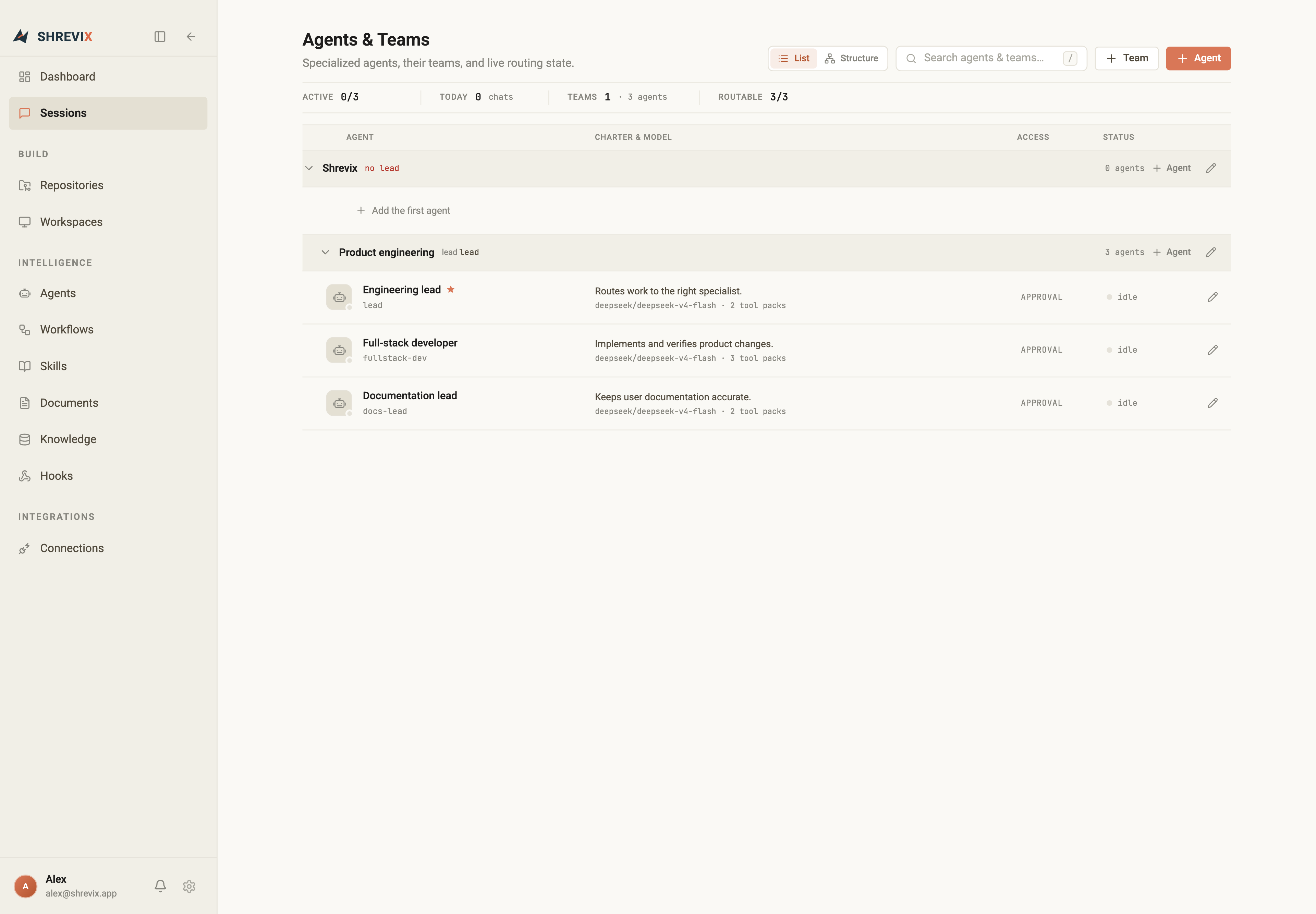
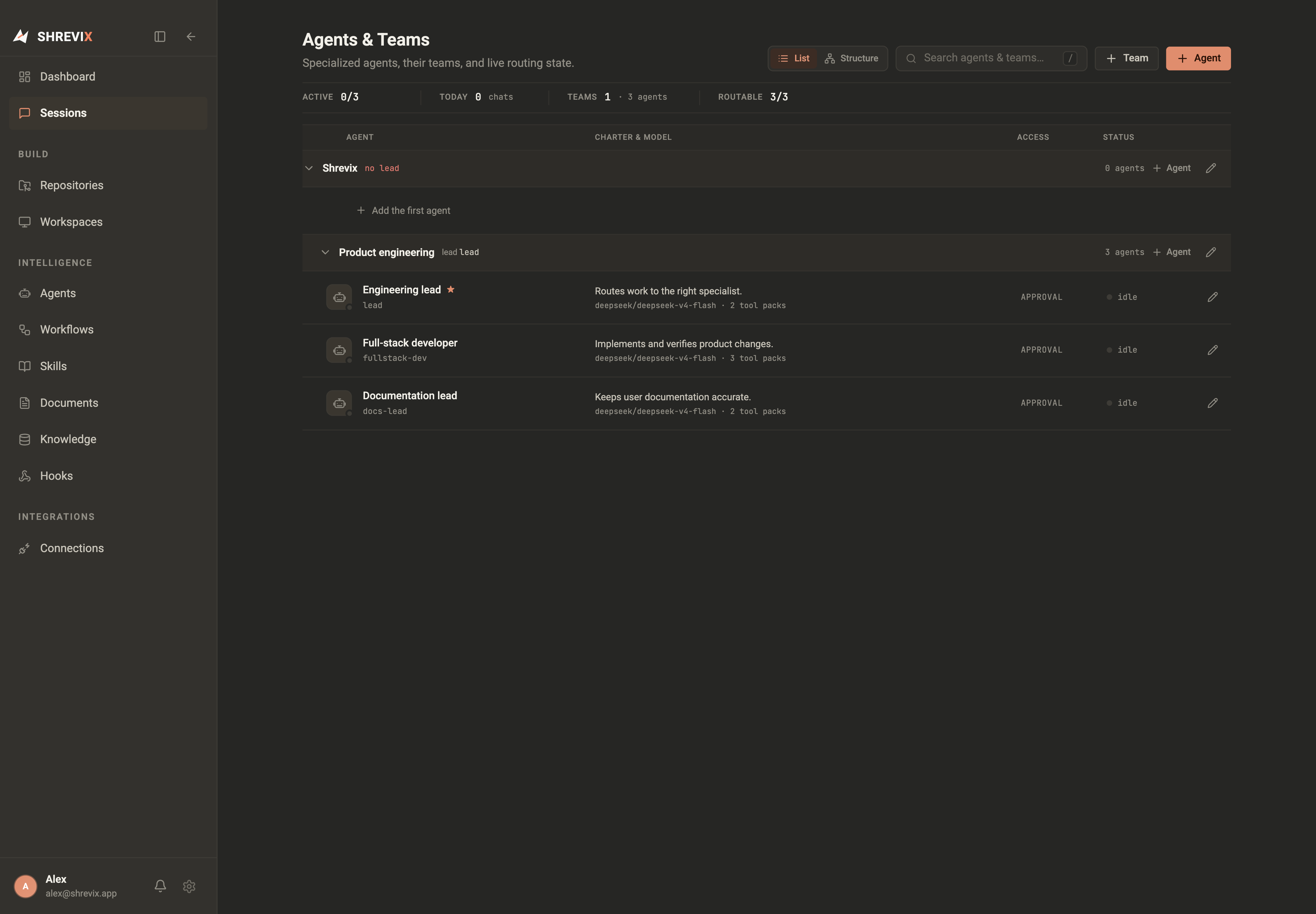
Two views of the same organisation
Section titled “Two views of the same organisation”Use the view toggle beside search:
- List keeps teams and agents in a compact operational list. Expand a team to see its members, live state, charter, permissions, and recent work.
- Organisation structure shows reporting relationships and team leads when the hierarchy matters more than density.
Editing either view changes the same underlying organisation.
You can also ask Shrevix in chat to inspect, create, update, move, or delete agents and teams. It resolves exact saved handles and team names before making a change, and organisation mutations follow the active approval policy.
Automatic and explicit routing
Section titled “Automatic and explicit routing”When a request fits a configured specialist, a lead is instructed to call
list_agents, inspect the available roster, and delegate to the appropriate
handle. If you name an agent explicitly, the routing instruction requires that
exact agent rather than a substitute. Selection quality still depends on clear
agent descriptions and the active model following those instructions.
An agent needs a clear charter to be routable. Keep the trigger language concrete: what work it owns, what it should avoid, and when another agent is a better fit.
Delegation in the transcript
Section titled “Delegation in the transcript”Delegation is shown once, at the point it happened. While the child is running, the parent keeps a small live card near the composer. When it finishes, the temporary card disappears and the original event remains in chronological order.
The delegated run is also a normal, openable conversation. Its thinking, task list, tool calls, diffs, approvals, and result stay in that child transcript; the parent receives the handoff and result without duplicating every child event.
Permission inheritance
Section titled “Permission inheritance”A child keeps its configured tool allowlist. It also inherits the parent turn’s active safety mode: Plan keeps delegated work read-only, while Bypass keeps approved prompt-free execution consistent across the parent and child. Without a parent override, the child’s configured approval level applies.
Parallel delegation
Section titled “Parallel delegation”Leads can delegate independent assignments in parallel. Dependencies and write scopes remain explicit so two agents do not silently edit the same surface. Each child produces its own durable run record and linked session. A single parallel batch can contain up to fifty assignments, while a turn can schedule any number of successive batches. Dependency-ready children share the parent runtime instead of launching one runtime process per agent.